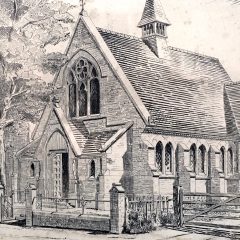
On Saturday 23rd April 2022, there was a civic service to mark two centuries of the life of Higham Congregational Church. The Bible reading was John 2:13-22 and the text:
The zeal of thine house hath eaten me up. (John 2:17)
I love the Church. To say it sounds incredibly unfashionable. The Church is despised by so many, including some who profess Christianity. I am speaking of the Church in every sense of the word. I love this building, the traditions and patterns of worship and of corporate life, and the people, past and present.
This church is a miracle in my view. It has survived the vicissitudes of 200 years. It has done so with no pastor ever appointed. Many churches (but not all, of course) flag and struggle between pastorates. Higham Chapel has never had a pastor. It has depended on the Lord and on the labour of members of the congregation. To sustain that for two centuries is something of a miracle.
Individual Christian’s have had to make sacrifices and demonstrate great commitment. Some of their names are in the brief history that appears elsewhere here. Some are not identified, or they made their contribution since the history was written. (It probably calls for a supplement to the document.). The founders were ordinary people from the Medway towns who had the vision for Higham and held meetings from 1817. They contributed what they could to share the message of the Christian Gospel. We do not know where they met initially, but they were able to construct a wooden chapel in 1821.
I recall my first visit to the chapel. I walked through the main door and looked to the front of the Sanctuary. It was the end of the Sunday School lesson, and Mrs Sutton and others were in front of the pews, with a crowd of joyful children around them. Children’s work has always featured in Congregational churches, but it is demanding and so much has to be poured into sustaining it. Such has been the zeal of the Lord’s people.
The disciples recognised the zeal of the Lord Jesus for the house of God when He went into the temple and objected to the activity of vendors and money changers. It would appear that Jesus did that twice. He challenged the practice at the beginning of His ministry, as recorded by John. Then He repeated it just before His arrest and trial, as found in the synoptic gospels. That the activity continued would suggest that it was the established pattern and considered quite normal. On the latter occasion, Jesus accused the tradesmen of extortion and dishonesty, but on the former He made no reference to lack of integrity and objected simply to using the temple for business. He apparently felt strongly about the sacredness of the house of God. The disciples remembered the words of Psalm 69:9: the zeal of thine house hath eaten me up. That Psalm was a prophecy concerning the Messiah. If relatively ignorant men like the disciples could see that the Lord’s action in the temple resembled that prophesied of the Christ, perhaps the religious leaders saw it as a claim to be the Messiah. Hence, they asked Jesus for a miraculous sign to legitimise His implied claim. In response, Jesus said, “Destroy this temple, and in three days I will raise it up. (John 2:19). He had in mind, not the Jerusalem place of worship, but His body. His bodily resurrection would be the evidence of His Messiahship.
Christians follow the crucified, dead and buried Christ who is risen and alive. During this Easter week, I have been teaching young children the story of the resurrection. One mother arrived at the kindergarten gate saying with approval that her son had come home excitedly announcing that Jesus was crucified and is alive again. This is the good news that the Church has to share. Often the Church is seen as fragmented and riddled with divisions, but though there are differences of opinion, we are united in our belief that Christ is risen, and He is the King.
Woven through these reflections are these three features of the life of the Christian Church: it is about
(1) counterculture – We have to ignore the ungodly culture of secular society and pursue a Church culture. Never mind what is fashionable. For many years, society followed the Church; it is no longer so. Christians cannot follow the world. We must be countercultural.
(2) costly commitment – serving Christ in a godless world can cost much. We need to exert ourselves and make sacrifices for the cause of the kingdom and the work of the Church.
(3) Christ the King – This is the most important thing to be said about the identity of the Church: we are all about the crucified and risen Lord, Christ the King.
Let us be consumed with zeal for the sanctuary, the servants of the Lord and the Saviour Himself.

 Higham Congregational Church
Thank you for adding your bicentenary sermon to this site. It is lovely to recollect the special service we attended last month with my cousin, uncle and auntie and the warm welcome my children and I received from everybody. It is also lovely to be able to share the link for this sermon with the rest of the family. Our sincere thank you to you all for continuing the work at this dearly loved chapel which has been faithful for 200 years with Christ’s blessing and enabling: “He that abideth in Me, and I in him, the same bringeth forth much fruit..” (John 15.5). My family join the ranks of hundreds if not thousands of children who have enjoyed a warm welcome here. We pray that the new generation of children in Higham have the opportunity as I had to know and to love this special place of worship and call it their own.
LikeLiked by 1 person
Thank you for your encouragement. What a thought: the hundreds – or even thousands – of children who have been touched by two centuries of gospel ministry at the chapel. We shall endeavour to perpetuate that tradition of sharing the word with the little lambs.
LikeLike